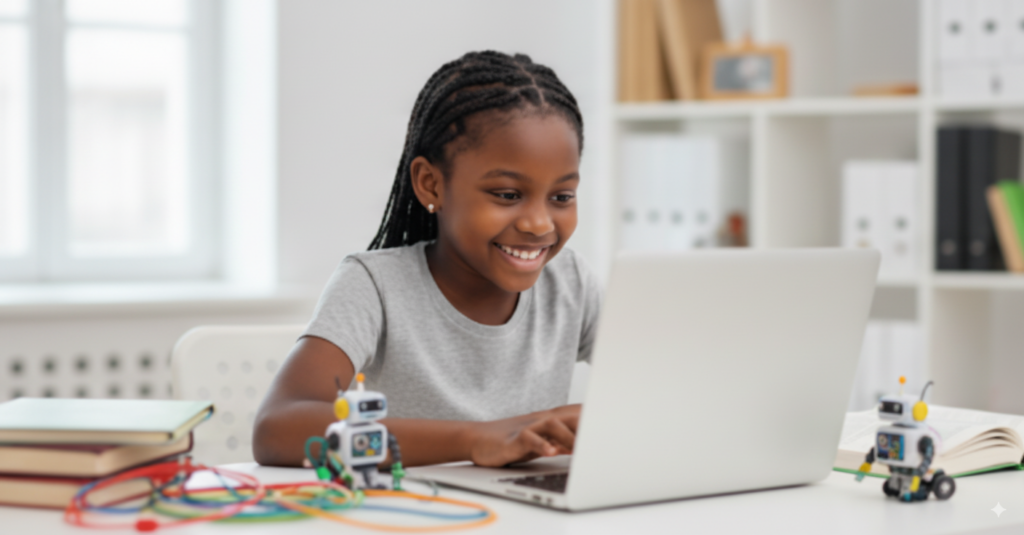
When parents hear about coding classes for children, one of the first questions they often ask is:
“Does my child have to become a software developer?”
My answer is always the same:
Absolutely not.
One of the biggest misconceptions about coding is that its only purpose is to prepare children for careers in software development. While coding can certainly open doors to exciting opportunities in technology, its true value goes far beyond learning how to write computer programs.
Coding teaches children how to think.
More specifically, it teaches them how to solve problems.
The World Needs Problem-Solvers
Every day, people encounter problems that require solutions.
Businesses solve customer challenges.
Doctors solve health challenges.
Engineers solve technical challenges.
Entrepreneurs solve market challenges.
Teachers solve learning challenges.
Regardless of career path, success often comes down to the ability to identify problems and develop effective solutions.
This is one of the reasons coding has become such an important skill for young learners.
Coding Teaches Children How to Think Logically
When children learn to code, they quickly discover that computers only do exactly what they are instructed to do.
This teaches them to think carefully and logically.
They learn how to:
- Break down complex tasks
- Follow step-by-step processes
- Organize information
- Identify patterns
- Test ideas systematically
These thinking skills can be applied in virtually every area of life.
Mistakes Become Learning Opportunities
One of the most valuable lessons coding teaches is that mistakes are normal.
Every programmer encounters errors.
Every project faces challenges.
Every solution goes through revisions.
Rather than becoming discouraged by mistakes, children learn how to:
- Investigate problems
- Analyze outcomes
- Try different approaches
- Improve their solutions
This process helps build resilience, persistence, and confidence.
Coding Encourages Creativity
Many people think coding is purely technical.
In reality, coding is incredibly creative.
Children use coding to:
- Build games
- Create animations
- Design websites
- Develop apps
- Program robots
- Bring ideas to life
Coding gives children the opportunity to transform imagination into reality.
Future Careers Will Reward These Skills
The future workforce will place increasing value on individuals who can:
- Solve problems
- Think critically
- Adapt quickly
- Collaborate effectively
- Leverage technology
These abilities are becoming essential across industries.
Even children who never pursue technology careers can benefit tremendously from developing the mindset that coding encourages.
Coding Helps Children Become Creators
Today’s children interact with technology constantly.
They use smartphones, tablets, websites, social media platforms, and digital tools every day.
But there is a significant difference between using technology and understanding how it works.
Coding helps children move from being passive consumers of technology to active creators.
Instead of simply playing games, they can build games.
Instead of only browsing websites, they can create websites.
Instead of just using technology, they can shape it.
More Than a Technical Skill
At its heart, coding is not really about computers.
It is about creativity.
It is about curiosity.
It is about persistence.
It is about learning how to solve problems.
These are skills that remain valuable regardless of how technology changes in the future.
As parents and educators, our goal should not simply be to prepare children for jobs.
Our goal should be to prepare them for life.
Coding is one of the many tools that can help us achieve that goal by developing confident, creative, and capable young people who are ready to embrace future opportunities.
The greatest benefit of coding is not that it teaches children how to program computers.
It is that it teaches them how to think, create, and solve problems in a rapidly changing world.