The world our children are growing up in is changing rapidly.
Technology is transforming industries, Artificial Intelligence is reshaping how we work, and new opportunities are emerging faster than ever before. As a result, academic excellence alone is no longer enough to guarantee future success.
While strong grades remain important, children also need skills that help them adapt, innovate, collaborate, and solve problems in a constantly evolving world.
As parents and educators, our responsibility is not only to prepare children for examinations but also to prepare them for life.
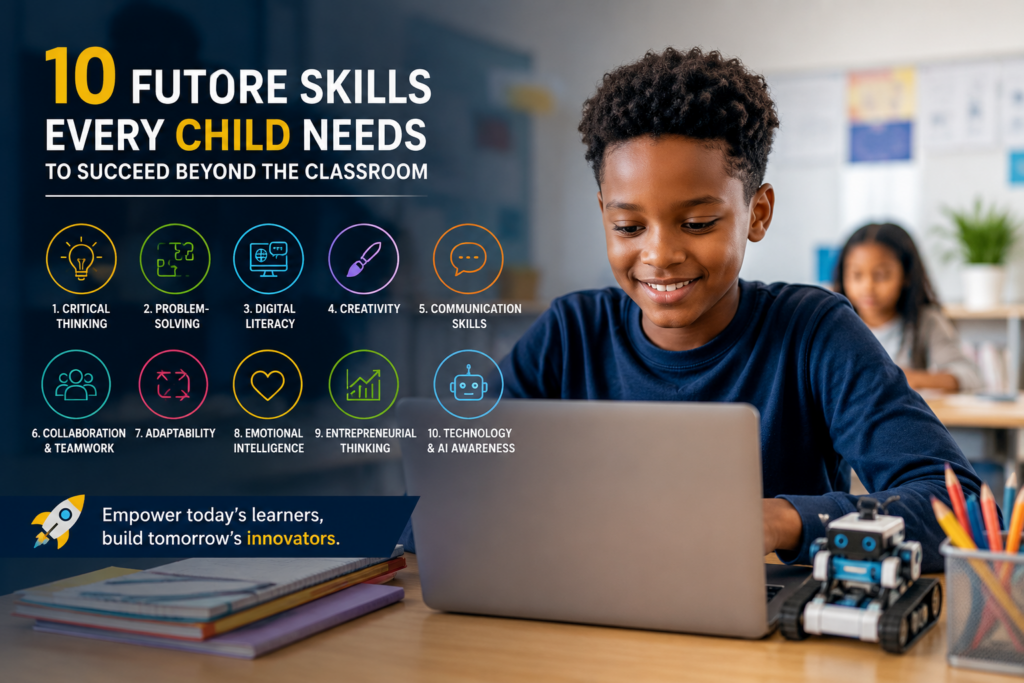
Here are ten future-ready skills every child should develop beyond the classroom.
1. Critical Thinking
In a world filled with information, children must learn how to think independently.
Critical thinking helps young people evaluate information, ask meaningful questions, identify problems, and make informed decisions.
This skill becomes even more important in an era where Artificial Intelligence can generate information instantly.
2. Problem-Solving
Every challenge presents an opportunity to create a solution.
Children who learn how to analyse situations, think creatively, and develop solutions are better equipped to succeed in any field.
Problem-solving is one of the most valuable skills employers consistently seek.
3. Digital Literacy
Technology is now part of almost every profession.
Children should understand how to use digital tools responsibly, safely, and effectively.
Digital literacy includes:
- Online research
- Cyber safety
- Responsible technology use
- Digital communication
- Understanding emerging technologies
4. Creativity
Creativity drives innovation.
Whether designing products, solving problems, building businesses, or creating content, creative thinking helps children develop unique ideas and approaches.
As technology automates routine tasks, creativity becomes even more valuable.
5. Communication Skills
The ability to communicate ideas clearly is essential.
Children should develop confidence in:
- Speaking
- Writing
- Presenting
- Listening
- Collaborating
Strong communication skills help learners succeed academically and professionally.
6. Adaptability
The future will continue to change.
Children who can embrace change, learn new skills, and adjust to new situations will be better prepared for emerging opportunities.
Adaptability is quickly becoming one of the most important career and life skills.
7. Collaboration and Teamwork
Most real-world problems are solved by teams, not individuals.
Children should learn how to:
- Work with others
- Share ideas
- Respect different perspectives
- Contribute effectively in group settings
These experiences help prepare them for future workplaces and leadership roles.
8. Emotional Intelligence
Understanding emotions is just as important as understanding technology.
Children who develop emotional intelligence are better able to:
- Build relationships
- Manage conflict
- Show empathy
- Lead others
- Work effectively in teams
These skills remain uniquely human and highly valuable.
9. Entrepreneurial Thinking
Entrepreneurial thinking is not only for business owners.
It is about identifying opportunities, taking initiative, solving problems, and creating value.
Children who develop this mindset learn how to think proactively rather than waiting for opportunities to come to them.
10. Technology and AI Awareness
Artificial Intelligence and emerging technologies will continue shaping the future.
Children do not need to become technology experts, but they should understand:
- How technology works
- How AI impacts society
- Responsible use of digital tools
- Opportunities created by innovation
Technology awareness helps children become active participants in the future rather than passive observers.
Preparing Children for Life, Not Just Exams
Success in the future will require more than academic knowledge.
The most successful individuals will combine strong educational foundations with skills such as creativity, communication, adaptability, problem-solving, and digital literacy.
Schools, parents, and communities all have a role to play in helping children develop these abilities.
By intentionally nurturing these future-ready skills, we can equip young people with the confidence and capability to thrive in a world that continues to evolve.
The future belongs to lifelong learners, creative thinkers, effective communicators, and problem-solvers.
The best time to begin developing these skills is today.