The digital world offers incredible opportunities for learning, creativity, communication, and growth. Children today have access to information and educational resources that previous generations could only dream of.
However, alongside these opportunities come significant responsibilities and risks.
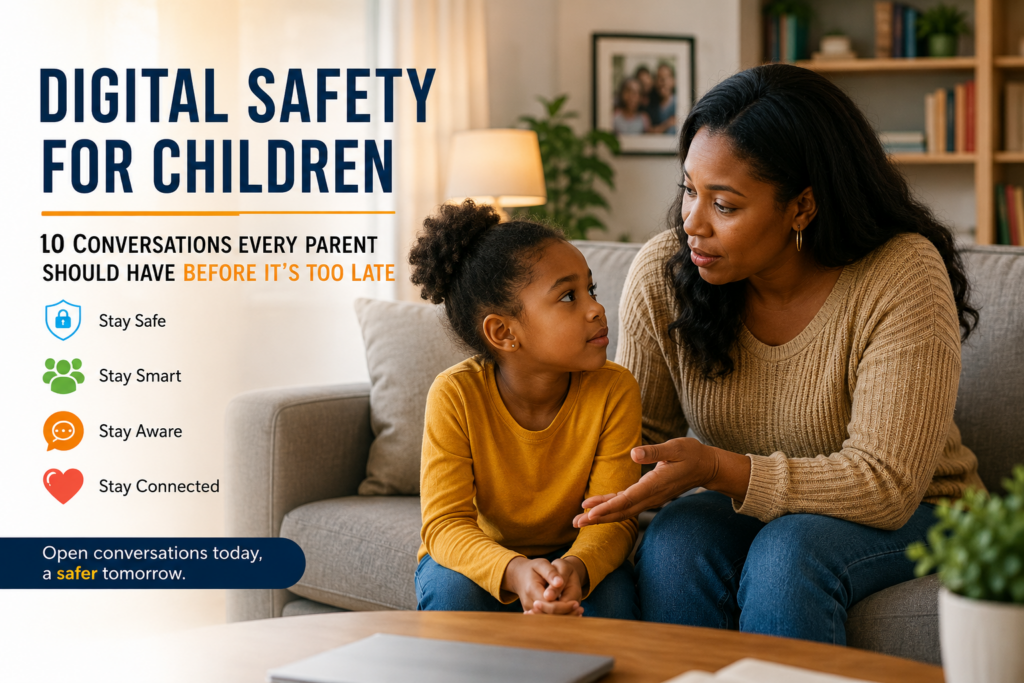
Many parents focus on monitoring devices, installing parental controls, and limiting screen time. While these measures can be helpful, one of the most powerful tools for keeping children safe online is something much simpler:
Regular conversations.
Children who understand digital safety are better equipped to make smart decisions, recognise potential dangers, and seek help when necessary.
Here are ten important conversations every parent should have with their child.
1. The Internet Never Truly Forgets
Children often assume that deleting a message, photo, or video means it is gone forever.
In reality, digital content can be copied, shared, archived, and redistributed long after it is removed.
Help children understand that anything posted online should be treated as potentially permanent.
A good question to ask is:
“Would you be comfortable if your teacher, parents, or future employer saw this?”
2. Not Everyone Online Is Who They Claim to Be
One of the most important digital safety lessons is understanding that online identities can be misleading.
Children should know that people may misrepresent themselves online and that they should be cautious when interacting with strangers.
Encourage them to immediately report suspicious conversations or uncomfortable interactions.
3. Personal Information Should Be Protected
Many children do not fully understand what qualifies as personal information.
Explain why details such as:
- Home address
- Phone number
- School name
- Passwords
- Family information
- Financial information
should never be shared without permission.
Privacy is one of the foundations of digital safety.
4. Cyberbullying Is Real
Bullying does not only happen on the playground.
It can happen through messages, social media, online games, and group chats.
Children should understand that:
- Hurtful messages are not acceptable.
- They should not participate in online bullying.
- They should report cyberbullying immediately.
- Seeking help is a sign of strength, not weakness.
5. Everything Online Is Not True
We live in a world where misinformation spreads quickly.
Children should learn to question what they see online and develop healthy scepticism.
Teach them to:
- Verify information
- Check multiple sources
- Ask questions
- Think critically before believing or sharing content
These skills are becoming increasingly important in the age of Artificial Intelligence.
6. Technology Should Not Replace Real-Life Relationships
Technology is a wonderful tool, but it should not replace meaningful human connections.
Talk to children about the importance of:
- Family time
- Friendships
- Face-to-face communication
- Outdoor activities
- Healthy social interactions
Balance is essential.
7. Mistakes Can Happen Online
Children should know that mistakes are normal.
The important thing is that they feel safe discussing those mistakes with trusted adults.
Whether they click a suspicious link, share something inappropriate, or encounter harmful content, they should know they can seek help without fear of immediate punishment.
Open communication is one of the strongest forms of protection.
8. Artificial Intelligence Requires Responsible Use
AI tools are becoming increasingly accessible to children.
Parents should discuss:
- Responsible use of AI
- Verifying AI-generated information
- Avoiding overreliance on technology
- Using AI as a learning tool rather than a shortcut
Understanding AI early helps children become informed digital citizens.
9. Passwords Matter
Many children underestimate the importance of password security.
Teach them to:
- Create strong passwords
- Avoid sharing passwords with friends
- Use different passwords when possible
- Understand why account security matters
These habits can protect them for years to come.
10. Technology Is a Tool, Not a Lifestyle
Perhaps the most important conversation of all is helping children understand the role technology should play in their lives.
Technology should be used to:
- Learn
- Create
- Explore
- Solve problems
- Communicate
It should not become the centre of their identity or daily existence.
Encourage children to view technology as a powerful tool for growth and opportunity.
The Most Important Safety Tool Is Communication
No parental control software can replace a healthy relationship between parents and children.
The safest children online are often those who feel comfortable discussing their experiences, challenges, concerns, and questions with trusted adults.
Digital safety is not a single conversation.
It is an ongoing dialogue.
As technology continues to evolve, parents must remain engaged, informed, and proactive.
The goal is not to create fear around technology.
The goal is to help children use technology confidently, responsibly, and safely while taking advantage of the opportunities it provides.
The earlier these conversations begin, the better prepared children will be to navigate the digital world with wisdom and confidence.